
AidLink
The worldwide link between aid organizations and donors.
This project was developed as the final project for the postgraduate Digital Experience Design, Belas Artes, Universidade de Lisboa. The challenge was to create an MVP to solve a social problem.

My role
May - Jun 2024
Academic Project — Postgraduate, University of Lisbon
Mariana Gonçalves, Amy Moraes, Carolina Cipriano
Challenge
The challenge was to create an MVP to solve a social problem. After some research and brainstorm sections, we shared several ideas and we decided to think about Climate and War-related disasters, which are very serious social problems these days.
This project is from 2024, but unfortunately, the subject is even more relevant today, in 2026, because of the ongoing wars and climate disasters.

Workflow
The project was developed in 42 days. The main methods are listed below, and my main tasks are highlighted in dark purple. The tasks in light purple are the ones shared with my project partners.

Context
Climate-related disasters are increasing
Globally, every year, we see climate-related disasters affecting several regions. Raul Cordero, professor at the University of Groningen, NL, explains: “Fueled by extreme weather and climate extremes, the frequency of climate-related disasters has dramatically risen in recent years (… ) in some regions of the world, we are facing climate-fueled disasters for which we are not prepared, and it is unlikely that we will be able to fully adapt to them.”
Armed conflicts are rising
From early 2024 to early 2026, there are over 50 active state-based armed conflicts worldwide (1). While we have many conflicts in regions such as Russia, Ukraine, and the Middle East, over 2 billion human beings are suffering from the consequences of the hostile environments (2). The war-related disasters are creating a huge humanitarian crisis worldwide, where people are in hunger, displacement, and have issues getting the bare minimum to survive.
Fonts: ACLED (Armed Conflict Location & Event Data), UCDP (Uppsala Conflict Data Program), UNOCHA (UN Office for the Coordination of Humanitarian Affairs).
Problem Statment
While we have a humanitarian crisis, we also have people who are looking for ways to help
💡It is crucial to create a link between all aid organizations for a humanitarian system that prevents, prepares, anticipates, and alleviates the suffering of all affected communities.
Research & Benchmarking
After idealizing our idea, we collected several ideas from existing digital products and services that operate in related areas, and we understood that there was ****no platform performing the same service that we wanted to provide.
We have conducted desk research followed by interviews with individuals who work on diverse social projects to understand our main users.
We explored the practical tasks and emotional points of view with the interviewees, such as the importance of the services provided, why they wanted to help in the first moment and how they operate or how the institution operates the aid services.
Insights
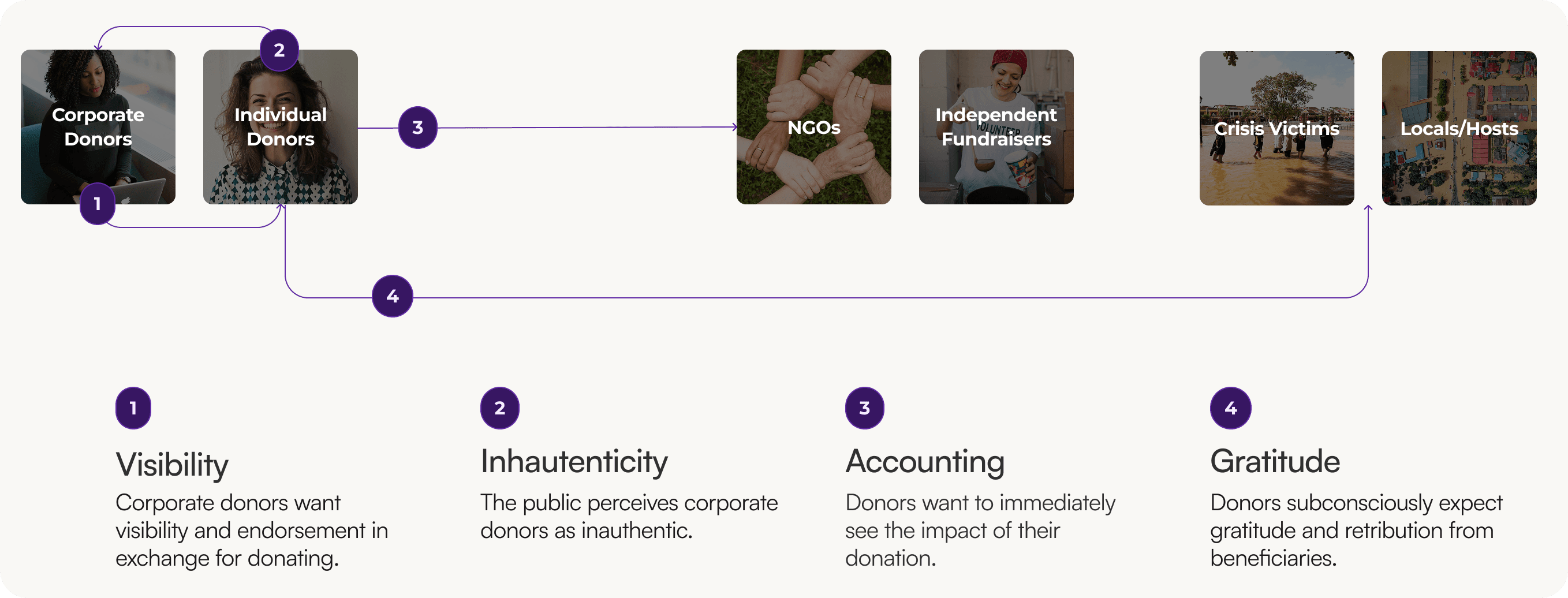
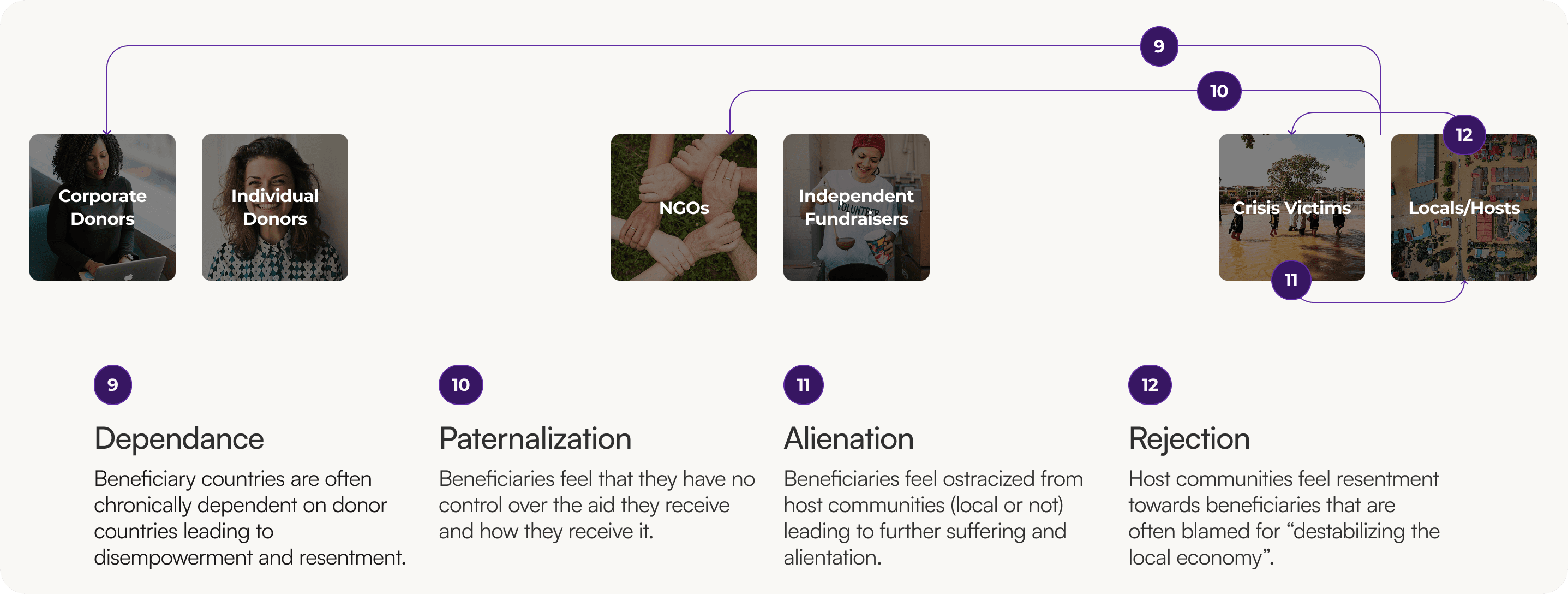
By analyzing the information collected during the research and interviews phase, we established our main agents and the complex relationship between them
Main agents

Conflicts we identified in the relationship between these agents
We understood the complexity of the relationships among the agents we tracked. People usually take actions with intention, expecting some results, or because they believe that the action is important somehow. Considering these interactions, we developed the following system that explains the actions, fellings and behavior of donors, the foundations, and the beneficiaries.

✨Value Proposition
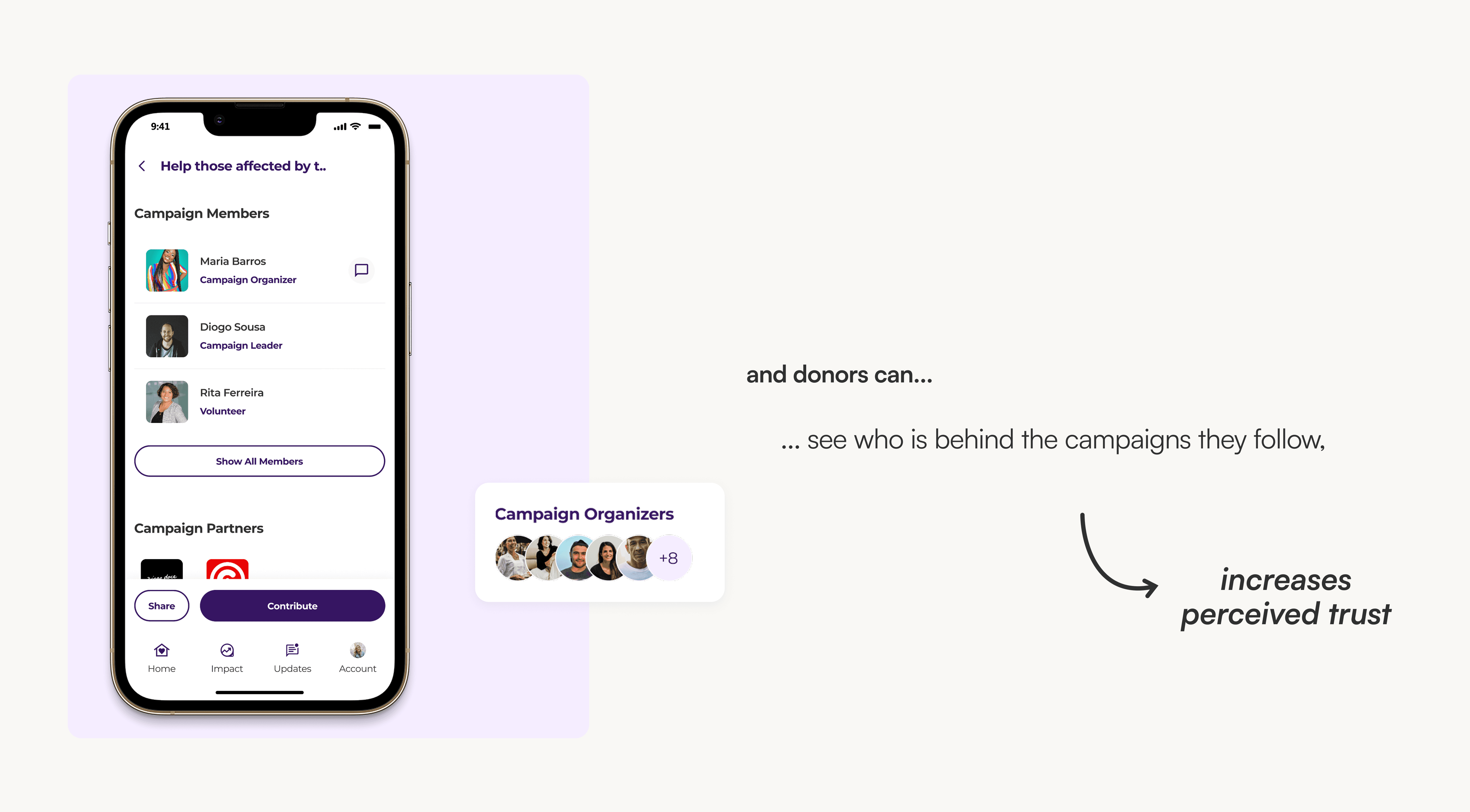
By understanding our agents' needs, we developed a digital product and service solution that enables donors and fundraisers to organize and share their campaigns, and beneficiaries to access the goods and services they need easily and quickly.
Solution
Our solution prioritaze the main needs of the users I already presented here.


Development
We understood the complexity of the relationships among the agents we tracked. People usually take actions with intention, expecting some results, or because they believe that the action is important somehow. Considering these interactions, we developed the following system that explains the actions, fellings and behavior of donors, the foundations, and the beneficiaries.
User Test
Through the tool Maze, we tested the MVP with potential users to validate flows, screens, and the usability of the application.
I created four tasks at Maze and asked the users to follow the paths. They weren´t long tasks, so users could perform them in a few seconds.
I have analysed all the interactions and presented the insights to my partners, so we could better adapt the application. It helped to have a general idea about the usability of the app. Even though we had important insights, only fundamental changes were implemented in the end.
Below we can see a print from User Test results and notes related to each finding.

Prototype
Explore our prototype on the Figma link below:
Conclusion
The goal of this project was to create an MVP, and there are many features and improvements we wanted to implement in the future.
Even for a University project, we are very proud of our work and the results of the project.